
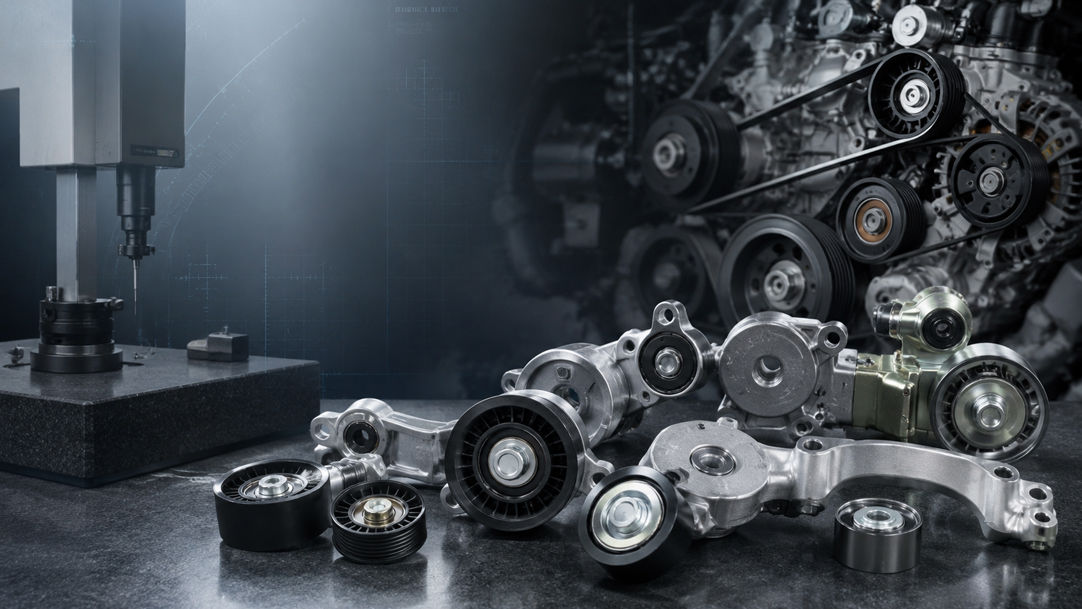
Small Components with a Major Impact on Belt Systems
Timing belt tensioners and idler pulleys may look like small engine components, but they play a critical role in maintaining belt tension, guiding belt movement, and reducing noise and vibration. If the quality of a tensioner or idler pulley is unstable, it may lead to belt misalignment, abnormal wear, noise, or repeated repair.
For aftermarket buyers, choosing a timing belt tensioner manufacturer or idler pulley supplier is not only about unit price. Buyers should also evaluate application knowledge, bearing quality, pulley surface processing, material selection, packaging, and aftersales support.
Four Key Points Buyers Should Evaluate
First, bearing and pulley stability. Tensioners and idler pulleys operate under continuous speed and temperature changes. If bearing quality or pulley surface processing is unstable, noise and abnormal wear may occur. Buyers should ask suppliers for clear product photos, dimensional confirmation, and necessary inspection information.
Second, application and OE cross-reference support. In the aftermarket, parts may look similar but differ in mounting holes, pulley diameter, offset, or bracket angle. Suppliers that can help confirm OE numbers and cross references reduce shipment errors and claims.
Third, packaging and labeling. Tensioners and idler pulleys are often sold with other kit components. Clear labels, part numbers, application information, and packaging methods help distributors manage inventory and shipments.
Fourth, quality management process. Queen Jen follows an ISO 9001:2015 quality management foundation and emphasizes incoming, in-process, finished product, and pre-shipment checks. For overseas customers, stable communication and basic inspection support are essential for long-term cooperation.
The Value of a Taiwan Supplier
Queen Jen has long served the automotive aftermarket with products such as timing belt tensioner bearings, idler pulleys, hydraulic tensioners, alternator pulleys, and related kits. Beyond products, Queen Jen supports customers with application checking, customized packaging, export operations, and multi-product sourcing coordination.
FAQ
Q1: What is the difference between a tensioner and an idler pulley?
A: A tensioner maintains belt tension, while an idler pulley guides the belt path. Both affect belt system stability.
Q2: What information should buyers provide when sourcing?
A: OE number, sample photos, dimensions, vehicle applications, packaging requirements, and target market are helpful.
Q3: Can Queen Jen support kit combination suggestions?
A: Yes. Queen Jen can discuss tensioner, idler pulley, and related kit combinations based on customer market needs.
- How to Choose a Reliable Timing Chain Kit Supplier for the North American and Global Aftermarket
- From ICE to Hybrid Vehicles: Aftermarket Opportunities for Alternator Overrunning Pulleys and Idler Components
- Why Global Buyers Choose a Taiwan Automotive Parts Supplier: Quality Control, Packaging, and Export Advantages
- Why Complete Timing Belt Kits Are Preferred in the North American Aftermarket: Advantages of a Taiwan Timing Belt Kit Supplier